


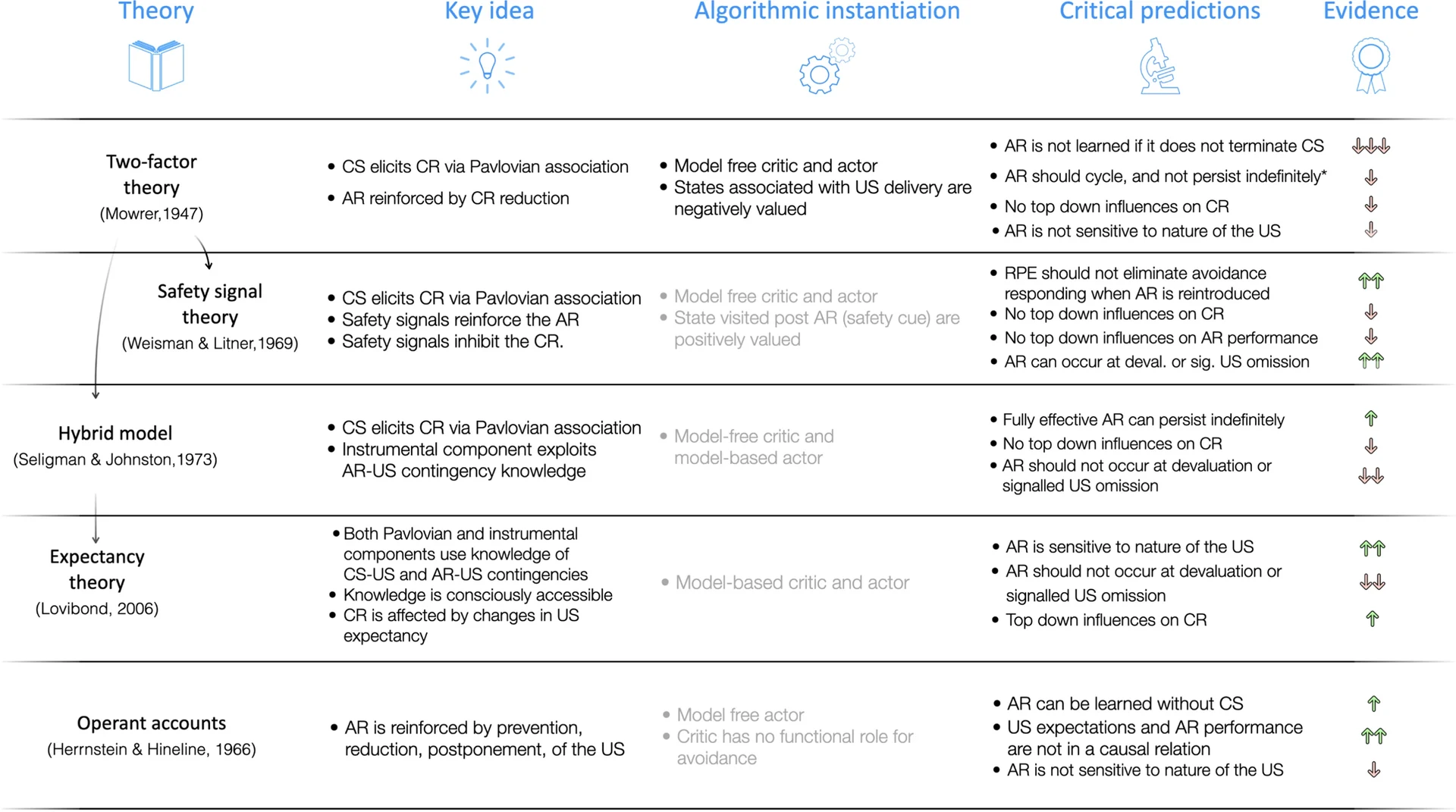
Published in Neuroscience and Biobehavioral Reviews, the review brings together evidence from 116 studies on human avoidance learning, systematically evaluating the empirical findings against competing cognitive and computational theories.
The evidence most strongly supports expectancy- and inference-based accounts, in which avoidance responses are selected according to represented consequences. At the same time, the review shows that no existing framework can fully explain the available evidence. Action valuation — including the efficacy and cost of an avoidance response — as well as Pavlovian influences and contextual or latent-state control also appear to play important roles.
The authors also identify an important methodological challenge: much of the existing research uses highly simplified laboratory tasks that differ substantially from avoidance in everyday life. They therefore call for more naturalistic experimental paradigms, richer action possibilities and approaches that can better capture the computational demands of real-world avoidance.
The review provides a foundation for refining theories and computational models of avoidance learning, while pointing towards new experimental approaches that could ultimately contribute to a better understanding of avoidance and its clinical relevance.