


Associative learning, like many mature fields of psychology, is endowed with a nearly unfathomable wealth of empirical data. These arise from multiple experimental procedures and animal species. To assess any proposed theory of associative learning, decisions must be made about which behavioral phenomena to account for. However, there is currently no systematic approach to prioritize observations within this body of evidence.
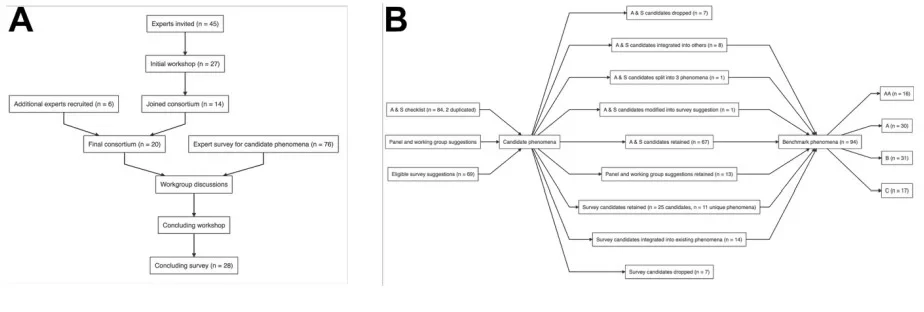
Here, we propose a set of benchmarks that theories should explain: phenomena that are robust across experiments, generalize across procedural variations, and occur under broad but clearly specified circumstances. We queried the expert community for phenomena to be included, reviewed the relevant literature, graded the phenomena into four categories of robustness and generality, and compared our gradings with a second survey of the expert community. We identified 94 benchmark phenomena, of which 16 are domain- and species-general and hence should be explained by any theory claiming generality, and 30 are species- and/or domain-specific but highly robust across procedures.
Strikingly, some textbook phenomena that have motivated influential and general associative learning theories are not among these. The remaining 48 phenomena were either tied to particular experimental procedures or of inconclusive generality. Some of their boundary conditions appear to be informally known across laboratories but rarely investigated in a systematic manner.
Thus, our review provides a comprehensive evaluation of the current evidence, which will direct theorizing towards high-priority phenomena while also re-focusing research into areas in which evidence is lacking.